Which Apple card sits in your hand decides what it sells for: a $100 media card pays ₦122,500 as sealed plastic and ₦104,000 as an e-code. Apple has sold three cards under shifting names, and only two of them trade on this market's main board. Below: how to tell which card you hold, what it pays and why, the WhatsApp trade in the order that keeps you safe, and the traps built around Apple cards specifically.
Which of Apple's three cards are you holding?
Probably the one that says Apple Gift Card — but check, because the name decides the market you can sell into. Since mid-2020 Apple has sold one unified card covering apps, subscriptions and hardware. Before it came two retired cards that never stopped working: the App Store & iTunes card (its codes begin with X) and the Apple Store card, which only ever bought hardware. Ask a Lagos phone shop for an "iTunes card" and any of the three might come out of the drawer — the names blur in daily trade.
Here is what the names mean for a sale. Both media cards — the unified Apple Gift Card and the App Store & iTunes card — redeem into the same Apple Account balance, so they earn the same board rate; an old iTunes-branded card loses nothing to its age. The Apple Store hardware card is a different product with its own pricing, quoted per card. If the names still blur, our Apple naming decoder walks all three with pictures — and in a trade, one photo of the card face settles it instantly.
What your Apple card pays in naira
On the current board (Aug 13, 2026), a $100 US Apple card goes for ₦122,500 on plastic, ₦104,000 as a code. Two dials decide that figure up front. The form matters most: an e-code pays roughly 15% under sealed plastic at the same size, because a code already out in the world carries a history nobody can audit — a photographed code could have been spent minutes after the photo — so the market pays less for that risk. Size comes second: the per-dollar rate jumps at $100 and again at $300, so a single $100 card beats a pair of $50s. The full ladder sits on the Apple selling page, every amount from $25 to $1,000 is answered in our Apple amount guide, and the Apple rate calculator prices your exact card in one tap.
Region is the third dial, and it is binary. The published board prices US-issued Apple cards — the issue this market trades — and Apple's own gift card terms say cards "purchased in the United States … can only be used for purchases in the United States". A UK or other-region card is a different product on the resale side too: message us first and we quote it case by case, never off the US figures.
One honest note on "pays today": every figure here is written in naira, so the currency market moves the rows. The naira settled at a two-year high near ₦1,322 per dollar on the official market this week, per Nairametrics; street desks averaged about ₦1,405 on September 3, per NgnRates' black-market page. The board refreshes monthly, and the written figure in your chat holds for the trade.
How the WhatsApp trade runs, in the safe order
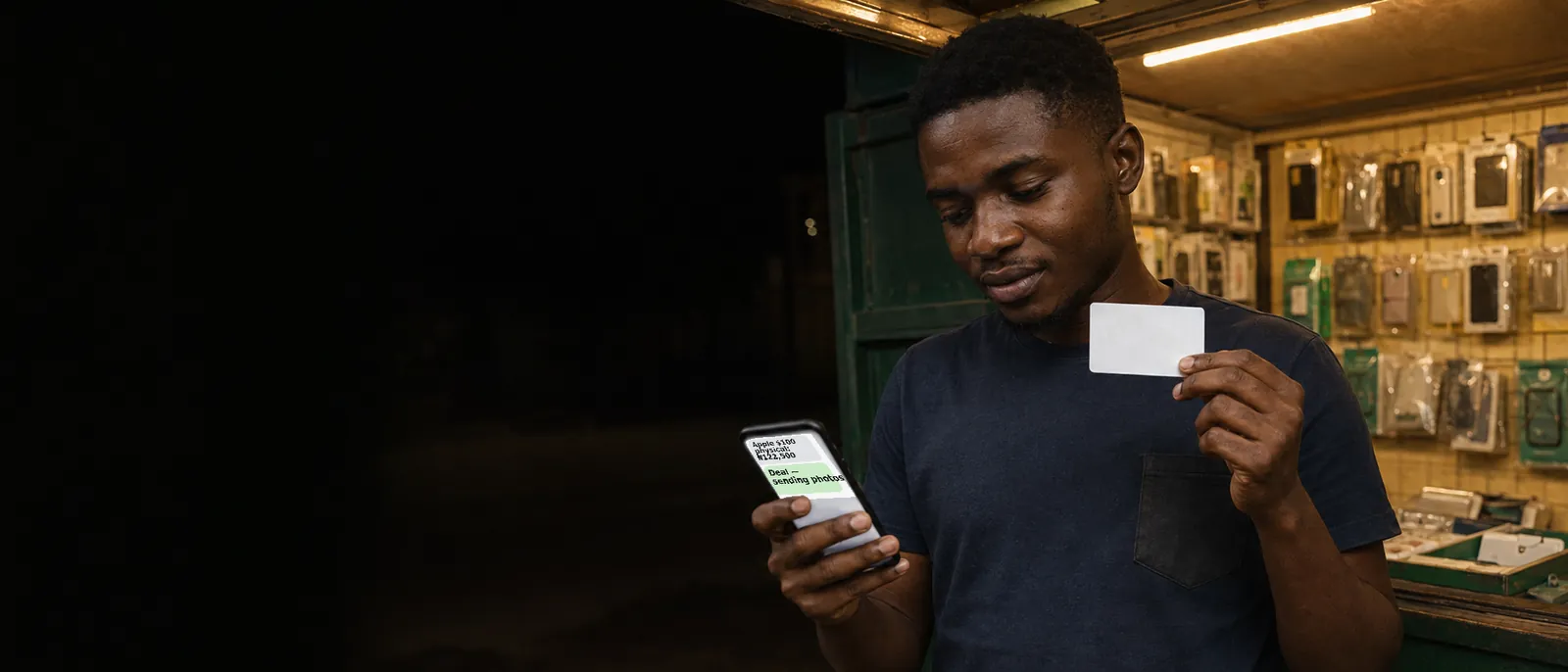
A sale at our counter is three messages and a transfer. Open with the brand, the amount and the form — "Apple, $100, physical" is enough; if you are unsure which name you hold, a front photo answers it. What comes back is your exact naira figure, in writing, inside the chat. Nothing spendable leaves your hand before that figure exists in writing — that ordering is the whole safety mechanism, and a buyer who reverses it is telling you something.
Then the card travels. Plastic goes as front-and-back photos, with the till receipt if you still have it — paper proves where the card came from before anyone asks, and provenance is what a buyer prices. An e-code goes as the code text with its delivery email alongside. Verification on an Apple card is a balance read, not a redemption: the value confirms, payment moves to the Nigerian bank account you named inside the quarter-hour, and you acknowledge the alert in the chat — that closes the trade.
And a move worth making before you message anyone: read the balance yourself. Apple keeps an official check page at secure.store.apple.com/shop/giftcard/balance, behind your own Apple Account — and checking there never redeems the card, per Apple's own walkthrough. Very few brands allow that; Steam has no checker at all, which is why its trades run differently. Our brand-by-brand balance guide maps every official checker. If a stranger claims only they can verify your card, you have just read the first line of the scam script.
What goes wrong around Apple cards
Apple cards sit near the center of gift-card fraud worldwide. In the US Federal Trade Commission's most recent brand-level ranking (December 2021), "Google Play gift cards were next, followed by Apple, eBay, and Walmart cards" among the most-reported scam payment brands, with a median reported loss of $800 on Apple cards. The pattern Apple itself warns about is the upstream trap: a stranger tells you to buy Apple cards and read out the codes as "payment" for a prize, a loan or a made-up fine. Apple's own scam page is blunt about the tell — "If someone asks you to use Apple gift cards to purchase something not sold by Apple, you might be the target of a scam". If that sentence describes your situation, close the chat and buy nothing.
The selling side has its own quiet traps. The classic is the buyer who must "check the code first". Best Buy's corporate office documented the canonical version back in 2017: the "buyer" has the seller call the retailer's balance checker on a conference line, records the touchtones as the card number goes in, and drains the funds moments later. Its advice still holds: "Never provide a potential buyer with the gift card number or PIN." On Apple the trick is exposed by the fact above — you can read the balance yourself, so nobody needs your code to quote you. The cousins come in two plays. One is the doctored credit alert — in the US FTC's words, "They send you a fake payment notification and hope you send the item before you realize it's a scam". The other is the overpayment hurry-up: the buyer claims they "accidentally" paid too much and asks you to send the difference back — and the FTC names gift cards as one channel that refund demand travels. Our seller scam checklist walks both patterns and the recovery steps.
Rather spend the card than sell it?
That door is open too. A US Apple card redeems into a US Apple Account, and the balance covers apps, subscriptions, iCloud storage and — on the unified card — hardware; our Apple uses guide maps the full list. Timing even nudges the decision this month: Apple's own events page has a "Surprise and shine" keynote set for September 9, and the new iPhones it ushers in are exactly what a kept balance can go toward. The honest arithmetic: if you will genuinely use what the balance buys, spending beats any resale rate; if the card would sit in a drawer, take the naira figure.
The figure comes before the code
Send "Apple", the amount and the form — a front photo covers any doubt over the name — and the naira quote comes back in writing before you share anything spendable. Accept it, send the card, and the transfer follows verification, any day of the week.
Apple made the card simple; only the names complicate it. Identify yours, watch the figure arrive in writing, and let the code travel last. Done in that order, the rest is routine — Apple cards move daily on this market, plastic and codes alike.
Questions, answered
How much is a $100 Apple gift card in naira?
On this month’s board a $100 US Apple card pays ₦122,500 as sealed plastic and ₦104,000 as an e-code — a gap of about 15%, pricing the risk that a code already seen may already be spent. Bigger cards earn a better per-dollar rate (the $100 and $300 tiers improve it), and our Apple amount guide carries every size from $25 to $1,000 in both forms.
Can I sell an iTunes card the same way as an Apple card?
Yes. Apple merged its cards into one Apple Gift Card in 2020, and the older App Store & iTunes cards never stopped working — both names land in the same Apple Account balance, so an iTunes-branded card earns exactly the Apple board rate, whatever its age.
Can I sell an Apple Store (hardware) gift card?
The Apple Store card is a different product — it only ever bought hardware, and the resale market prices it apart from the media cards. The published board on this site rates the media cards (the unified Apple Gift Card and the App Store & iTunes card); a hardware card prices individually in chat — send a photo of the card face and you get a firm figure.
Can I sell a partly used Apple gift card?
No — only a card with its full value intact has a market. A partially redeemed Apple card is just an Apple Account balance with less on it, and balances cannot move between accounts. If you are unsure what remains, read the balance on Apple’s own check page (behind your Apple Account — checking never redeems) before you message anyone.
How do I avoid getting scammed when selling an Apple card?
Keep the order: a firm naira figure written in the chat first, the card or code only after that, payment right behind verification. Refuse anyone who needs the code “just to check it” — on Apple you can read the balance yourself on the official page, so no honest buyer needs your code to quote you. And test any new counter with a small card first.
Where can I sell my Apple gift card for cash in Nigeria?
Right here on WhatsApp — message “Apple”, the amount and the form, and the naira figure comes back in writing before you share the code; payment lands in your Nigerian bank account minutes after the card verifies. Wherever you sell, hold out for that same order: written quote first, code last.
Sell your card the safe way
No app, no sign-up — we confirm today's rate in writing before you send anything, and payout lands in your bank within 15 minutes of verification. Start with a small card if you want to test us first.
Sell my gift card