No — Apple Pay does not work with a Nigerian bank card. Apple keeps the list of banks allowed in, and no Nigerian issuer is on it. That is the short answer. The longer one earns its length, because three routes around the wall do exist: shops here already accept Apple Pay from foreign cards, a dollar virtual card can sometimes join the Wallet, and anyone paying Apple itself — apps, music, iCloud — can skip bank cards entirely with an Apple Account balance fed by gift cards. This guide runs each route the way a Nigerian iPhone owner meets it, in order, and keeps the ones that survive contact with Apple's own rules.
Apple Pay in Nigeria: the official answer
Apple Pay has never launched for Nigerian bank customers, and Apple says so itself — in the Nigerian locale. The company's participating-banks page, the very copy served for this country, lists exactly four African countries: Egypt, Mauritius, Morocco and South Africa. No Nigerian heading exists. The global list runs to about a hundred countries and regions, and Nigeria is not among them.
The mechanism explains the list. Apple Pay is not an app you install or an account you open; it is a tokenized copy of a bank card inside Apple Wallet, and it exists only where the card's issuer has signed Apple's tokenization agreement. No signature, no Wallet entry — which is why "when will Apple Pay come to Nigeria" is really a question for the banks, not for Apple. Under the list sits a line inviting visitors who can't find their bank to "check back soon." For Nigerian visitors, that sentence has nothing behind it yet.
Can you add a Nigerian card to Apple Wallet?
Try it, and Wallet refuses. Apple's troubleshooting page names the three errors that come back — "Could Not Add Card", "Invalid Card", "Card Device Limit" — and then states the rule that produces them: "Apple does not approve or decline cards for use with Apple Pay." The decision sits with the bank that issued the card. GTBank Mastercard, Access Visa, UBA Verve — the network printed on the plastic changes nothing, because Apple's list carries no Nigerian issuer of any network, Verve included.
Why the banks can't simply switch it on
What is missing is tokenization, not goodwill. Between 2020 and 2022, fighting dollar scarcity, Nigerian banks squeezed international spending on naira cards from about $100 a month down to $20 — then stopped it altogether: Standard Chartered in July 2022, First Bank that September, GTBank at the end of December, Zenith the following January (BusinessDay, Daily Trust, Technext). The freeze thawed only in mid-2025, and it thawed with ceilings: $500 a month at First Bank and Wema, $1,000 a quarter at GTBank (Forbes Africa).
None of that moves Apple Pay. An international-spending ceiling and an issuer tokenization agreement are different machinery — the first lets your naira card pay a foreign website, the second is what Apple Pay is made of, and no Nigerian bank has signed it. So even a 2025 naira card with its $500 headroom intact still draws "Invalid Card" from Wallet. Route one, closed: the card in your pocket cannot become an Apple Pay card.
Is Apple Pay available in Nigeria at all?
For a buyer holding a Nigerian card, no. For a shop, yes — Apple Pay entered Nigeria from the merchant side. Paystack has let Nigerian businesses take it online since 2021 (TechCrunch), and Paystack's own documentation states the condition plainly: the button appears only when "the customer has previously set up an Apple Pay account and added a card" — a card from a participating bank, which in practice means a foreign one. Flutterwave's channel table lists Apple Pay among its naira payment channels.
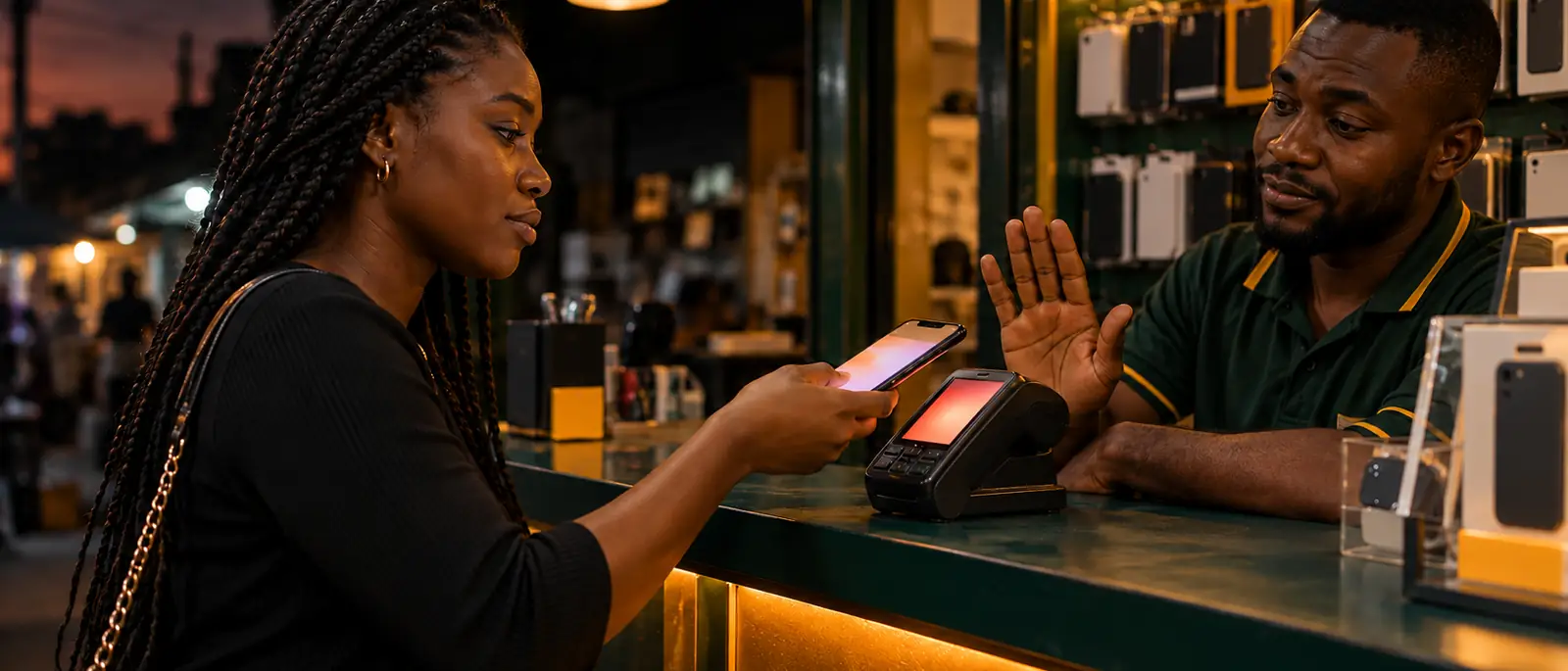
The terminal side arrived in December 2025, when Nomba switched on Apple Pay tap-to-pay across its POS network. Ecofin's report puts the coverage at "over 300,000 physical merchant locations" in Nomba's telling, and names the oddity at the center of it: "the average Nigerian consumer still cannot add their local Naira Mastercard or Visa card to an Apple Wallet." So the machine at the counter does accept Apple Pay. It cannot accept it from your naira card — the visitor's UK card taps, yours transfers.
Where contactless payment exists here, it runs under the CBN's June 2023 guidelines: ₦15,000 per tap and ₦50,000 a day before a PIN is required (BusinessDay). That ceiling frames what tap-to-pay is for in Nigeria even as it spreads — food, fuel, the everyday counter — and it sits on the terminal side too, whoever's card is tapping. Route two works here. It just doesn't work for a card issued here.
The virtual dollar card detour, without the sales pitch
One category of Nigerian-funded card can join Apple Wallet: a US-dollar virtual card whose issuing bank — usually an American partner bank behind a fintech app — has signed with Apple. When it works, it works fully: tap-to-pay where terminals take it, online checkouts, in-app payments. Read the caveats before the promise. The list of working providers changes without notice, because it depends on an issuer's standing with Apple, not on any app's marketing; funding and conversion fees sit between your naira and every dollar the card spends; and the blogs ranking these cards sell them.
We issue no payment cards and sell none, so this guide names none. If you take the detour, verify the issuer on Apple's participating-banks list first, fund the card small, and treat any "this one works" claim as perishable. Route three survives — with conditions attached, and a bank behind it after all.
The route that needs no bank: the Apple Account balance
Every Apple service a Nigerian can buy accepts an Apple Account balance, and the balance fills from an Apple gift card — no bank card anywhere in the loop. Apps and in-app purchases, music and movies, Apple Music, Apple TV+, Apple Arcade, iCloud+ storage, subscriptions inside apps: Apple's what-you-can-buy page charges them all to the balance. Two walls matter. You cannot send gifts with it or share it — "funds that you add to your Apple Account balance are available only to you" — and Apple documents no way to turn a balance back into cash. Some purchases also ask for a credit card on file.
Loading it takes a minute. In the App Store, tap your photo, tap Redeem Code, scan or type the card's 16-digit code, and the face value lands as balance — Apple's redeem guide walks it with pictures, and our redemption walkthrough covers the same ground brand by brand. The rule that decides everything is the country match. Apple's gift-card terms say a card bought in the United States "can only be linked to an Account in the United States," and the redemption troubleshooting page gives the homely version: a card bought in France refuses the US App Store. In practice the pairing that reaches Nigeria is a US card onto a US Apple Account — the combination diaspora gift cards were bought for. Apple documents no Nigerian gift card at all, so a Nigerian-region account has no official card to fund it.
Which Apple card are you holding? The names deceive — the unified Apple Gift Card and its two retired predecessors trade differently in people's heads but redeem alike; our Apple naming decoder sorts them in ten seconds. The balance can even pay for Apple hardware in countries where Apple runs a checkout — Nigeria has none, and the card-to-iPhone verdict prices that gap. And if the card in your hand is worth more to you as naira than as apps: this month's board pays ₦123,000 for a physical $100 Apple card, ₦104,000 for the e-code. Route four stands — the only one of the four with no bank in the loop.
The bracket, complete:
| Route | What it needs | Verdict |
|---|---|---|
| Your naira card in Wallet | An issuer signature no Nigerian bank has given | Closed — "Invalid Card" |
| A foreign bank card | A card from a participating bank abroad | Works — for whoever holds one |
| A virtual dollar card | A fintech's foreign issuer, fees, and luck | Works — until the issuer drops out |
| Apple Account balance | An Apple gift card in your account's country | Works — no bank anywhere |
Spend it with Apple, or cash it with us
A US Apple card you won't redeem still pays. WhatsApp the card's country, form and face value, and you hold a written naira quote before anyone asks for a code. The Apple rate table publishes every line with its refresh date, and the calculator prices your exact amount in two taps.
How to set up Apple Pay in Nigeria with a foreign card
With a card from a participating foreign bank, setup works from inside Nigeria exactly as it works abroad, because nothing in the process checks where you are standing. Open Wallet, tap the plus button, choose Debit or Credit Card, scan the card, and let the bank verify you — its app, a text, sometimes a call (Apple's setup guide has the per-device version). From there the phone taps at any terminal that takes contactless, Nomba's fleet included, and at the Paystack or Flutterwave checkouts that show the Apple Pay button.
Two Apple products stay out of reach regardless: Apple Cash and the Apple Card are US-only by Apple's own footnotes. No setup ritual imports them. For everyone holding only naira cards, the picture to keep is the direction of travel: Apple Pay is entering Nigeria shop first, wallet last. Until a Nigerian issuer signs, the balance route is the one that asks nobody's permission.
Questions, answered
Can I add a Nigerian bank card to Apple Pay?
No. Apple’s participating-banks list has no Nigerian bank on it — no Verve, Mastercard or Visa issuer — so every naira card draws a Could Not Add Card or Invalid Card error from Wallet. The mid-2025 return of international spending on naira cards (about $500 a month at several banks) covers websites only; adding a card to Apple Pay needs a tokenization agreement no Nigerian bank has signed.
Does Apple Pay work at Nigerian shops and POS terminals?
At the terminal, yes — for foreign cards. Paystack and Flutterwave let Nigerian businesses accept Apple Pay online, and Nomba’s POS terminals have taken tap-to-pay since December 2025. But the card inside the Wallet must come from a participating foreign bank; a naira card cannot be added, so local buyers keep paying with transfers and bank apps.
How do I pay for Apple Music or iCloud in Nigeria without Apple Pay?
With an Apple Account balance. Redeem an Apple gift card in the App Store — your photo, then Redeem Code, then the 16-digit code — and the balance pays for Apple Music, iCloud+, apps and in-app subscriptions with no bank card on file. The card’s country must match the account’s: a US card funds a US Apple Account and no other.
Will Apple Pay ever launch in Nigeria?
Apple has announced no date. A country joins its list when local issuers sign Apple’s tokenization agreement, and the banks page only asks visitors to check back soon. Acceptance has so far arrived from the shop side — businesses here take Apple Pay from foreign cards — while the consumer side waits for the first Nigerian bank to sign.
Sell your card the safe way
No app, no sign-up — we confirm today's rate in writing before you send anything, and payout lands in your bank within 15 minutes of verification. Start with a small card if you want to test us first.
Sell my gift card