
A Steam card picture can show the card's form, face value and printed currency clues; it cannot show whether the code still holds money. A physical Steam gift card usually carries game artwork and a denomination on the front, with a redemption area on the back. Valve's direct digital gift follows another route through Steam accounts.
The references below separate those objects, then turn them into a clean photo set for a sale. Every teaching image hides the spendable code. Keep yours out of public posts and unsolicited chats too.
Physical Steam card pictures: start with the front
The front identifies the object as a physical Steam Gift Card and may display its denomination. Valve's reference shows $20, $30 and $50 USD cards with a collage of game artwork, a colored value band and the Steam name.

Read the large value first, then the currency beside it. A $50 marking tells you the card's original face value; it says nothing about the amount left today. The same distinction applies to £ and € cards.
Artwork is a weak identity check. Retail designs can differ by country, denomination or production run, and a copied photograph can reuse a real design. Treat an unfamiliar front as a reason to read the back, not as proof of a fake or an original.
The back: read the instructions and guard the code
The back carries the redemption area and any printed instructions or support identifiers attached to that card. Many layouts cover the code with a scratch panel. Keep that panel intact until you are ready to use the card or proceed with an agreed sale.
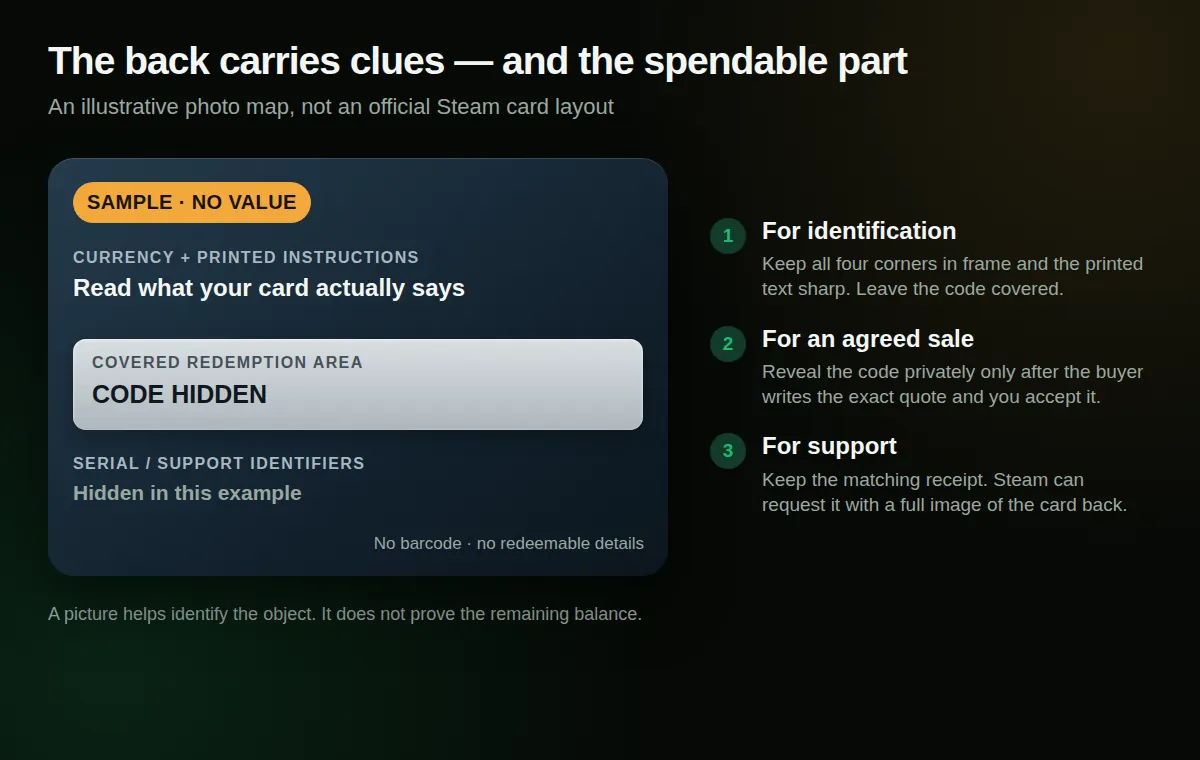
eBay tells its cardholders to keep the gift card and the store receipt as proof of purchase. That is sound recordkeeping for any card brand. For a stalled Steam card, our Steam error guide explains when to contact Steam Support and when the retailer must respond instead.
A full back photo exposes more than decoration. Do not post it in a group, attach it to a public listing or send it to a stranger who only wants to "look". Identification needs the card's shape, text and denomination; a public image does not need a readable code.
A direct digital gift is not a wallet-code email
Valve's direct digital Steam gift travels from one Steam account to another, so there is no plastic card or scratch panel to photograph. The recipient gets a gift through Steam and accepts it into their wallet.

Valve's digital gifting flow asks the buyer to select an amount, choose a friend and complete the purchase. That is different from a retailer selling a Steam Wallet code and delivering the characters by email, on a receipt or inside an online order. In this market, that retailer-delivered form is usually called an e-code.
| What you hold | How it arrives | What a useful image shows |
|---|---|---|
| Physical retail card | Plastic with front and back artwork | Whole card, denomination and printed clues; code stays private |
| Direct digital gift | A gift sent between Steam accounts | The gift and account context, not a scratch card |
| Retailer wallet code | Characters delivered digitally or printed on a receipt | Delivery source and currency; reveal the code only at the right sale stage |
This distinction prevents a common first-message mix-up. A friend's direct Steam gift has already entered the account-to-account flow. An unredeemed retailer code is still a separate piece of spendable text.
Which country or currency does the picture show?
Read the currency symbol and the printed wording instead of guessing from the artwork. The official example above says USD; other cards can show pounds or euros, and their backs or delivery documents may carry more precise country information.
Start with three clues: the symbol beside the face value, any country or redemption instruction printed on the back, and the retailer receipt or delivery email. When those clues disagree or are missing, mark the currency as unknown and ask before trading. A blue card is not evidence of a US issue, and a game scene proves no region at all.
Valve's supported-currency document lists no Nigerian naira, and its default rule charges in US dollars where no native currency exists. Our Steam card and wallet guide explains what that means for wallet-code matching, including why £ and € cards follow a different path. The photograph supplies the clue; the account rule decides what happens next.
How to photograph a Steam card for sale
A useful sale set shows the whole card, its face value and its currency without giving the code away early. Prepare the images before starting the chat, but keep the redemption area covered until the quote and buyer are settled.
- Put the card on a plain, matte surface. Include all four corners. Avoid fingers over the printed text, harsh flash and a scratched-panel close-up that leaves the rest of the card out.
- Take separate front and back images. Check them at full size on your phone. The denomination, currency symbol and small instructions must survive the compression that a chat app applies.
- Add the purchase receipt when you have it. Let the retailer, date and card details remain readable. Hide unrelated personal information and every spendable code in any image used only for identification.
- For an e-code, preserve the original delivery evidence. The email, order page or till slip should connect the code to its source and currency. Do not paste the characters into a public screenshot or send them to several prospective buyers.
Keep the original files too. Re-sending a compressed screenshot of a screenshot makes small characters harder to read, and Steam's redemption page is not a safe balance checker: entering the code there applies it to an account. Our Steam selling guide explains the verification step and the full trade sequence.
Clear photos shorten the first message
Tell us the card form, face value and currency, then check the US Steam rate table or the Steam calculator. We confirm your exact naira quote in writing before asking for the code.
What a Steam gift card picture cannot prove
A photograph cannot establish the remaining balance, the redemption history or the sender's right to sell the card. Those facts live in redemption and purchase records, not in pixels. Even an untouched scratch panel only tells you what the surface looks like.
A clean image can be copied from another listing. A real card can hold no value because somebody used its code before the photo reached you. And a receipt can belong to another card. Each item is evidence of one detail; no single item answers the whole trade.
Be especially careful when the conversation begins with a prize, loan, job or government demand. eBay's official scam guidance tells users not to pay anyone outside eBay with its gift card, and calls a seller who accepts only gift-card payment a scam. Apply the same skepticism when a stranger wants Steam cards and their pictures as payment. That request belongs in the bin, not in your photo gallery.
Use the picture to name what you hold. Use the written quote to decide when the code should move. Those two jobs stay separate, and the second one never happens in public.
Questions, answered
What does a Steam gift card look like?
A physical card pairs game-themed artwork with a printed denomination; the reverse holds its redemption instructions and code area. Valve’s digital gift is a graphic sent inside Steam, so it has no plastic back to scratch. Layouts differ, and appearance alone cannot verify value.
Where is the code on a Steam gift card?
On a standard plastic card, check the reverse for a covered redemption strip or panel. Retailer e-codes arrive as characters in an email, online order or printed till receipt. Keep the characters concealed except inside a verified support case or an agreed private trade.
Is a Steam digital gift card the same as a Steam Wallet code?
No. Valve’s direct gift moves between Steam accounts and is accepted by the named friend. A wallet code is separate text issued through a retailer for manual redemption. Their delivery evidence differs, even though both can add funds to Steam.
Can you tell whether a Steam card is original from a picture?
Not reliably. A copied image may display genuine artwork, while a genuine card may use an unfamiliar design. The photo also reveals neither prior redemption nor the balance left. Check the physical evidence and source, and never treat a logo as a guarantee.
What pictures should I send when selling a Steam card?
Prepare sharp full-card views of both sides, with the amount and currency legible, plus the receipt if available. Send sensitive code details only after accepting a written quote in a private trade. For an e-code, retain the source email or order record.
How do I know whether my Steam card is US, UK or EU?
Look for $, £ or € next to the face value, then corroborate it with the card’s instructions or the retailer’s delivery document. If the evidence is unclear, do not assign a region from the artwork alone.
Sell your card the safe way
No app, no sign-up — we confirm today's rate in writing before you send anything, and payout lands in your bank within 15 minutes of verification. Start with a small card if you want to test us first.
Sell my gift card