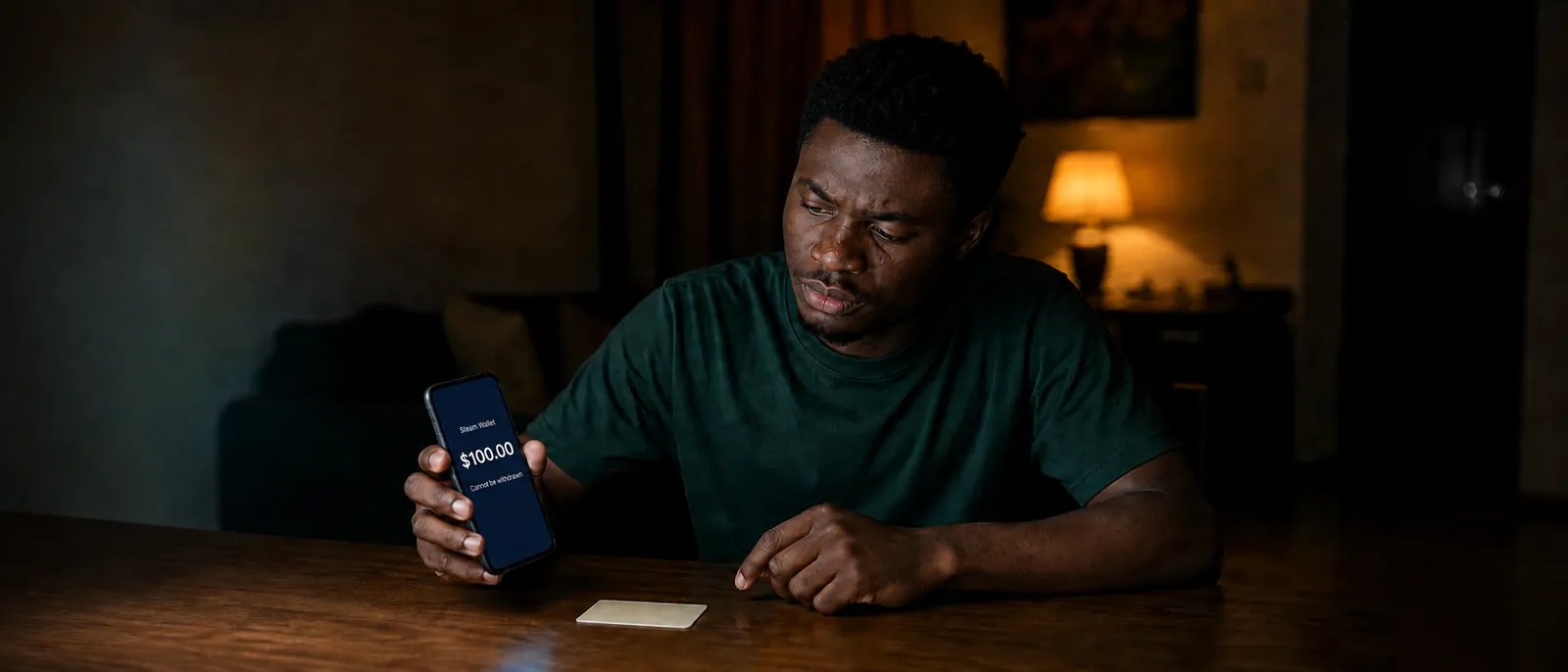
Can you cash out a Steam wallet to naira? No. Once a card is redeemed, its value becomes Steam Wallet funds, and Valve's own rules lock that balance inside Steam — no withdrawal to a bank, no transfer to another account, no conversion to cash, in Nigeria or anywhere else. The one thing that still sells for naira is the value before it enters a wallet: an unredeemed Steam card or code.
The honest answer forks at one moment — redemption. Before it, your card is sellable value; after it, the balance only moves in circles inside Steam. Find your side of that line first.
The three doors Valve has closed
None of the three obvious exits — withdrawing to a bank, moving the balance to someone else, refunding it back — exists, and Valve says so in its own documents. Each door, with the wording on it:
Door one: withdraw to a bank account. Steam has no withdrawal feature — for anyone, in any country. The Subscriber Agreement defines the wallet as a prepaid balance for ordering Steam content, legally distinct from a bank account, and Valve's own Wallet FAQ fields the question by name — "Can my Steam Wallet funds be gifted, withdrawn or transferred to another Steam account?" — then opens its answer with a single word: "No". There is no form to fill in, no threshold that unlocks one, no country where it works differently. Opay, PalmPay or GTBank, the answer is the same.
Door two: move the balance to another account. That same FAQ answer spells it out: "No, your Steam wallet funds cannot be moved or gifted to another Steam account." Middlemen online still offer to "transfer Steam balance" for a fee — the feature they claim to use does not exist. What Steam sells instead is one-way gifting: you can buy a digital card for a friend's account, but your own balance never travels.
Door three: refund it back. Steam's refund policy pays out "in Steam Wallet funds or through the same payment method you used to make the purchase" — and a redeemed gift card leaves no payment method behind it, so its value can only loop back into the wallet. The same page is blunter about cards like yours: Valve "cannot provide refunds for purchases made outside of Steam (for example, CD keys or Steam wallet cards purchased from third parties)". And the one wallet refund that does exist — fourteen days, unused, funds "purchased on Steam" — covers a top-up you bought yourself, not a card someone handed you.
Three doors, one architect — and the design is the point. Even abandoning the wallet doesn't free the money: the agreement adds that funds "deemed unclaimed property may be turned over to the applicable authority" — left long enough, a balance can end up with the state, but never back with you. Bitdefender's obituary for the retail card said it shorter: gift cards "function like digital cash and are difficult to recover once redeemed".
The fork: an unredeemed card is the one that still sells
All of that stops being bad news if you haven't redeemed yet. An unentered code belongs to no account — its value still sits on the plastic or in the email, unattached — and value that can still change hands is value that can be sold. That sale is the one clean exit to naira, and it pays the same month-long rates as any other trade: September's board pays ₦93,500 for a $100 US Steam card as sealed plastic; as a wallet code, the same $100 pays ₦89,000. The per-dollar line holds flat from $10 to $500, and our Steam amount guide prices every size — UK and euro cards included, on their own boards.
One honesty note on those figures: they are naira-denominated, so they breathe with the currency market. Daily Post's September 4 market report put the official close at ₦1,321.22 to the dollar with the parallel market flat at ₦1,400; NairaToday's tracker read the CBN window at ₦1,326.69 on September 5. Whatever a new month does to the maths, the rate calculator and the Steam (US) selling page always carry the current numbers.
What the sale itself looks like: one WhatsApp chat, the exact payout set down in the chat before anything travels, then the card or code, then the bank transfer behind it. Our Steam selling guide walks that route in full, and it matters here for one reason — the exit only exists while the code is unentered, so the order of the steps is what protects it.
Already redeemed? The honest audit of what's left
If the value already sits inside a wallet, four moves remain — one free, one social, one expensive, one fatal.
Spend it — the move the wallet was built for. Games, DLC and in-game content are what the balance is; our guide to what a Steam card pays for walks the catalogue. If you were going to spend anyway, time it: Valve's events calendar runs the Autumn Sale October 1–8, when the same balance buys noticeably more game.
Gift a game to a friend who repays you in naira. Steam supports gifting titles, so you can buy the game a friend wants and settle between yourselves. It is real but small-scale: it needs a friend who actually wants a game, trust on both sides, and an amount that fits a game's price.
The skins route — real, but toll-collecting. The one quasi-market exit: spend wallet funds on CS2 or Dota 2 items, then sell those items on a third-party skin marketplace for actual money. Count the tolls before you start: a 2026 fee breakdown by TradeUp Academy puts third-party cash prices "20% to 35% below Steam listings", and a cash-out guide by SteamLedger estimates the round trip returns 70–85% of wallet value, with a 7-day hold before items can even move. A regulated marketplace adds its own friction on top — one reviewer's first bank payout took about 11 days, with photo-ID and face-scan KYC once volumes pass roughly $1,000 (CS2Central's CSFloat review). And the trap inside the trap: selling on Steam's own Community Market exits nothing — the Market FAQ states "All Community Market sales and purchases are completed using the Steam Wallet", and the proceeds "cannot be withdrawn or transferred to another Steam account or to a bank/3rd party account". Market sales only refill the wallet you were trying to empty.
Selling the whole account — the fatal one. The Subscriber Agreement makes an account "strictly personal": "You may therefore not sell or charge others for the right to use your Account, or otherwise transfer your Account". And the teeth: an account terminated for violating the agreement gets "no refund, including of any Subscription fees or of any unused funds in your Steam Wallet". Beyond Valve's rules, account markets are where sellers meet chargebacks, recovery fraud and stolen-goods resales. Skip it.
When someone offers Steam codes as payment
Freelancers, vendors and social-media sellers in Nigeria do get offered Steam codes in place of naira. Our counter hears the pattern regularly, and no public tracker covers it — so treat this section as field notes, not statistics.
The first rule is pricing: a code offered as payment is goods to resell, not money to spend, so value it at what the resale board pays for it this month — never at face value times an exchange rate. The second rule is inspection: there is none. Steam runs no balance checker — our balance-check directory lists it among the redeem-only brands — so keying a code in anywhere "just to see" is not an inspection; it is the spend itself. Fix the exact naira amount in the chat before photos or codes move, and start a brand-new payer with a small code. And where you can, simply ask for naira instead — it skips every risk in this paragraph.
The mirror version of this trap runs the other way: a "buyer" or "agent" tells you to redeem a card yourself to activate or release a payment. The US Federal Trade Commission's wording covers every variant — "There's never a reason to pay for anything with a gift card" — and anyone reversing the flow is draining it; our scam checklist walks the patterns and the recovery steps. And a sign of how scam-dense this exact question is: researching this guide, we met fake "Steam cash-out eligibility" pages hosted on hijacked domains. None is real, and we link none.
Still on the card? Then it still sells
The payout question has a deadline — it must be asked while the code is still unentered. Message us with the card's brand, size and region, and the exact naira figure is typed into the chat before anything changes hands; once the card verifies, money moves. Cards already redeemed can't be bought — the wallet keeps those — so ask first, redeem never.
A Steam wallet is a one-way funnel: value pours in easily and pours out never. The naira exit lives on the near side of redemption — on the card, in the code, never in the wallet. If selling is the plan, keep the plastic unscratched and the code unentered, and let the sale happen while the value can still move.
Questions, answered
Can you transfer Steam wallet funds to another account?
No — Steam’s Wallet FAQ rules out moving or gifting a balance between accounts in any direction. The only official way to deliver value to someone else is one-way at purchase time: buy a digital gift card for their account. Your own balance can never follow.
Can I get a Steam refund paid into my bank account?
Only money you paid Steam directly can refund to its original payment method, and where that fails the refund lands in the wallet anyway — there is no path from a Steam wallet to a bank account. Redeemed gift-card value has no payment method on file to send anything back to — it can only circle back into the wallet. And Valve states outright that wallet cards bought from third parties cannot be refunded at all.
Is selling Steam skins a real way to cash out a wallet?
Real but lossy. Independent fee breakdowns put third-party cash prices 20–35% under Steam-market listings, one cash-out guide estimates you keep roughly 70–85% of what the wallet held, and regulated marketplaces add a 7-day trade hold, multi-day first payouts and ID checks beyond about $1,000. Selling on Steam’s own Community Market is never an exit — its proceeds are wallet funds by rule.
Someone wants to pay me in Steam codes — should I accept?
Only if you treat the codes as stock to sell on, not cash to spend: fix the naira amount in the chat up front, never enter a code you intend to pass on (on Steam, entering it is spending it), and open with the smallest denomination available. Asking for plain naira up front skips all of it.
Can I sell a Steam wallet code I haven’t redeemed?
Yes — an unredeemed code is exactly what the market buys. This month, sealed US plastic at the $100 size pays ₦93,500; the same card as a bare wallet code pays ₦89,000, with UK and euro cards priced on their own boards. In any safe trade the written quote comes first — our Steam selling guide walks the whole route.
Sell your card the safe way
No app, no sign-up — we confirm today's rate in writing before you send anything, and payout lands in your bank within 15 minutes of verification. Start with a small card if you want to test us first.
Sell my gift card